ALADIN Paves the Way for Circular and Demand-Driven Textile Production in Europe

KONTAKT

Head of Center of Management Research
Textile production can be organized sustainably by utilizing short supply chains and preventing overproduction. This can already be achieved today by intelligently connecting and efficiently utilizing existing infrastructure. At the same time, production becomes circular when innovative technologies and materials are used that enable high-quality recycling. The ALADIN research project, launched in May 2026 and co-funded with five million euros under the EU Horizon Europe program, is creating the conditions for this.
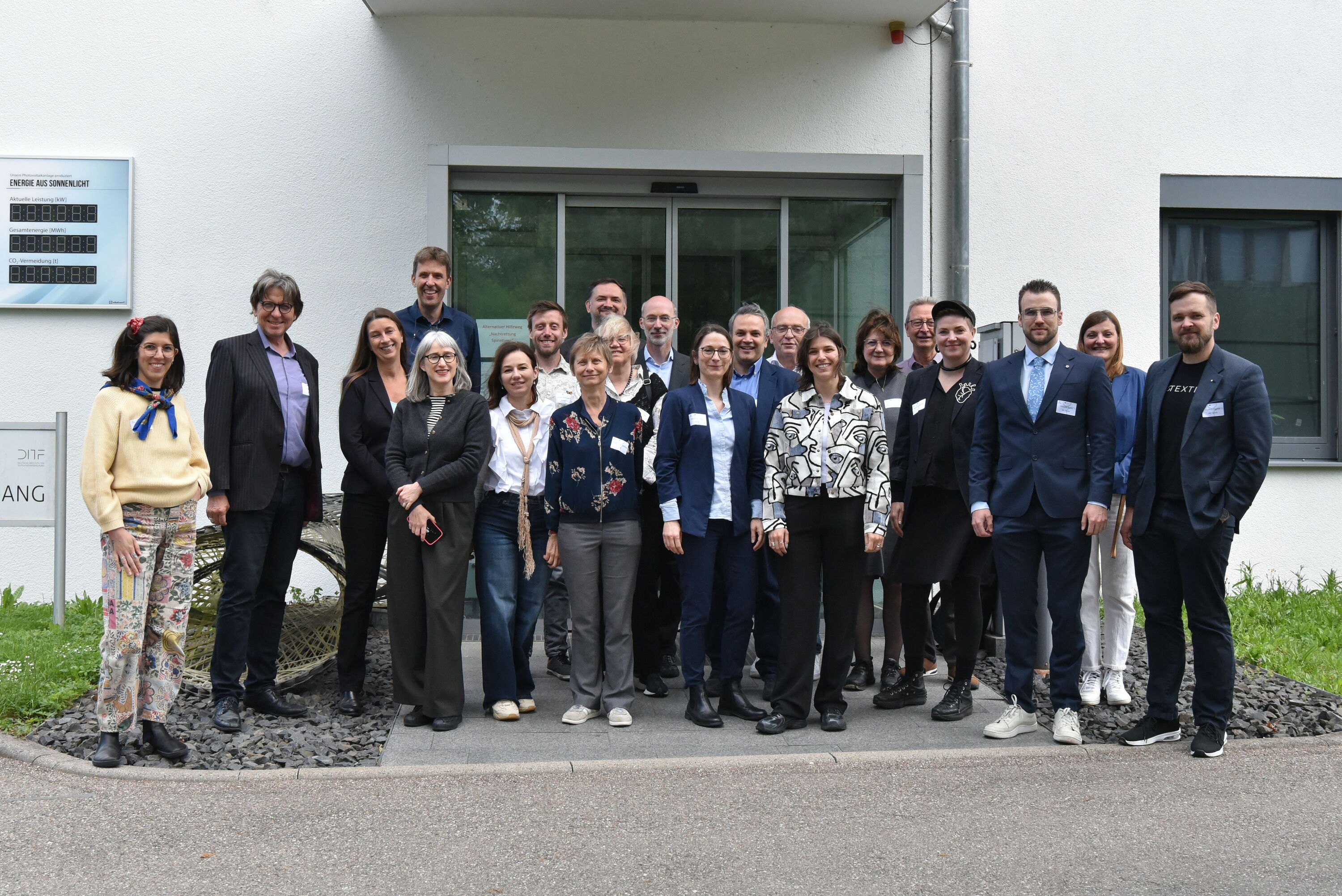
Under the coordination of the German Institutes of Textile and Fiber Research Denkendorf (DITF), ten European project partners are developing and integrating platforms, technologies, and viable business models for circular textile production over four years. ALADIN stands for Advanced LocAl and Digital Innovation Network for Circular Garments and aims to establish viable business models for circular textile production.
The concept is based on four pillars:
- A digital platform for services provided by small and medium-sized enterprises (SMEs)
- Regional cooperation to promote local production
- Technologies for recycling strategies
- Local and renewable raw materials
The project partners come from six different countries (Germany, Romania, Belgium, France, Czechia, Italy) and bring a wide range of expertise to the table, for example in the areas of design, embroidery, printing, digitalization, recycling, AI, and microfactory production.
This diverse range of experiences enables a high-performance digital infrastructure for B2B and B2B2C relationships. The partners will develop innovative technologies such as a Digital Product Passport module, or an AI-supported ecodesign assistant and apparel textiles including ring-spun recycled cotton yarns, while ensuring a broad transfer of project results to make a lasting impact. This will result in a network that jointly utilizes the infrastructure - from design and production to customer service and recycling.
To validate the approach, three specific use cases are being implemented: a semi-automated T-shirt, a smart parka, and a circular, versatile blazer dress. These products use sustainable materials such as bio-based fibers and recycled textiles, which are processed in a way that makes them easier to recycle at the end of their life cycle. Production takes place locally in microfactories, and the products are custom-made according to customer specifications.
In addition, small and medium-sized enterprises (SMEs), startups and further stakeholders will be actively involved in two Open Calls. Innovations within the ecosystem are also promoted, for example in the areas of automation, production technologies, and digital services.
In the long term, the project aims to establish a Europe-wide network of microfactories, create new jobs, and significantly increase the use of sustainable materials. At the same time, the project intends to reduce waste and strengthen regional value creation.
To this end, ALADIN brings together industry, customers, policymakers, and academia - to promote sustainable, circular textile production. In this way, ALADIN will also serve as a model for similar networks, thereby multiplying the positive effects on the market and the environment.

This project has received funding from the European Union’s Horizon Europe research and innovation programme under grant agreement No 101294463. Views and opinions expressed are however those of the author(s) only and do not necessarily reflect those of the European Union or the European Health and Digital Executive Agency (HADEA). Neither the European Union nor the granting authority can be held responsible for them.