CONTACT

Deputy Head of Competence Center Staple Fibers, Weaving [&] Simulation
Head of Numeric Simulation
Development of an energy-saving nozzle
Novel main nozzle for multi-colored weft insertion in air-jet weaving
Air-jet weaving is a productive technology with up to 1,200 wefts per minute. However, one disadvantage compared to rapier and projectile weaving machines is the high energy costs for compressed air. The weft yarn is usually inserted via four to eight main nozzles, whereby only one nozzle can be ideally arranged parallel to the reed channel. The other nozzles blow the compressed air at an angle to the reed channel, causing a lot of air to escape unused, creating air turbulence in the reed channel and promoting weft insertion errors. The yarn transport properties are different for each nozzle and therefore require higher pressure. This requires a special, expensive reed with a funnel-shaped inlet.
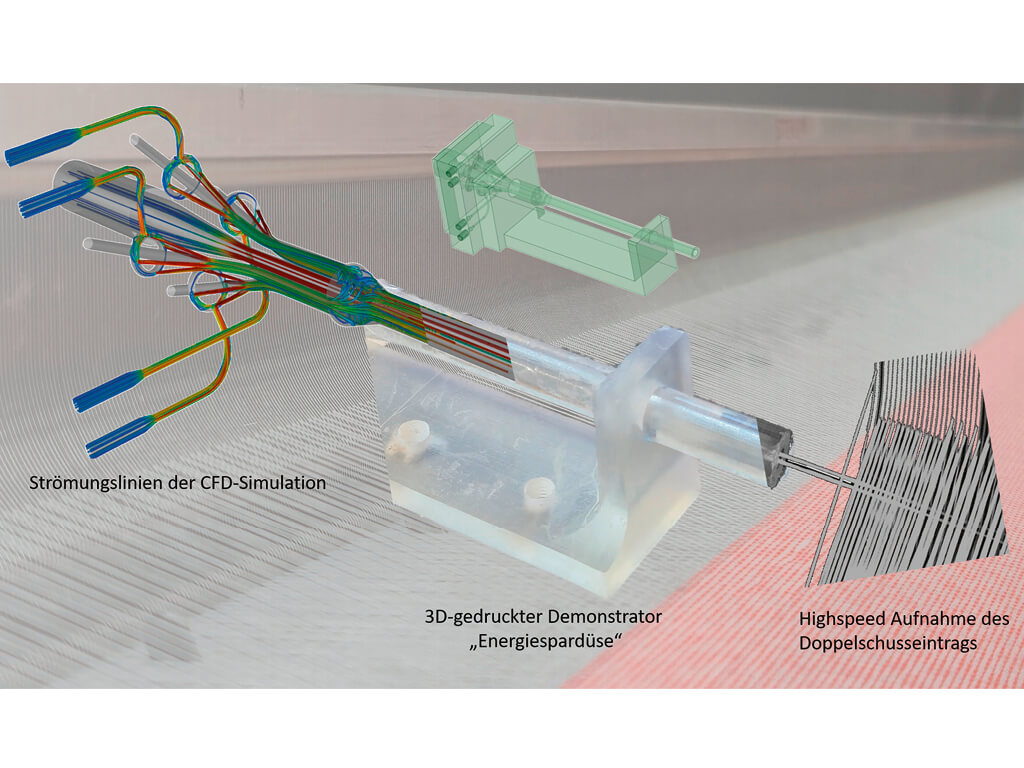
Productivity could be almost doubled with a double weft insertion, which is not possible with the current main nozzle system. A new, energy-saving main nozzle was therefore developed at the DITF. Several main nozzles, fixed or movable, were replaced by a single energy-saving nozzle, which is optimally positioned in relation to the reed channel and enables multicolor weft insertion. Flow simulations (CFD) were used to develop solution concepts, layout and optimize nozzle designs. The velocities, flow profiles and pressure losses for the different nozzle designs were analyzed, flow phenomena explained and the concept solutions evaluated in detail. This led to a nozzle design with reliable shot entry and optimum utilization of compressed air.
Demonstrators were produced using 3D printing, the dimensional accuracy was checked using μCT, the simulation models were verified using air flow measurements (Particle Image Velocimetry System, PIV) and the firing processes were documented using high-speed cameras. The demonstrators and also the double weft insertion were successfully tested on various DORNIER air-jet weaving machines.
The energy-saving jet offers new opportunities for competitive textile production in Germany with energy savings of over 12.1 percent, stable weft insertion, double weft capability and low-cost reeds. An additional plus point: the nozzle can also be used for existing weaving machines without major conversion.