CONTACT

Project completion “AI sensor”
Predicting the electrical properties of sensor yarns with AI
The IGF project “KI-Sensor” has been successfully completed. The aim of the research project was to investigate the potential of artificial intelligence for predicting the electrical properties of conductive yarns and embroidered pressure sensors.
In close cooperation between the center of Management Research at the DITF and the Technology Center E-Textiles [&] Acoustics, it was shown that AI models can predict the electrical properties of conductive yarns and textile sensors with sufficient accuracy to effectively support development processes. This can save significant costs and time in the development process.
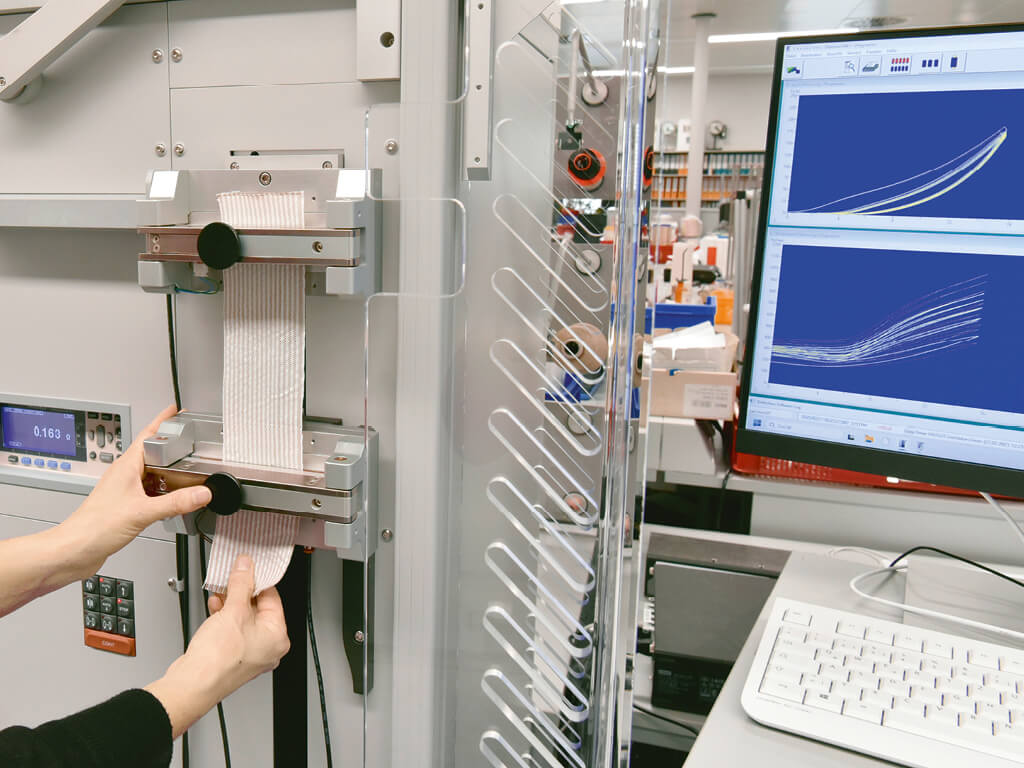
During the course of the project, it became clear that not only the static resistance behavior is relevant for the design. The changes in electrical resistance along the forcestrain curve are just as crucial, as the functional behavior changes significantly under load. A key finding concerns the importance of high-quality and standardized data for the successful use of AI. The project partners found that the development of resilient AI models is currently still hampered by a lack of or non-application of standards. For example, the resistance specifications in data sheets for conductive yarns are given in different forms such as 5 Ω ± 2 Ω or [lt] 100 Ω, while force-elongation measurements are often carried out under different framework conditions (e. g. clamping length, test speed or pretension weight).
Harmonization and standardization measures for measurement methods and data documentation are of central importance in order to use the knowledge gained in the long term and to further advance the industrial use of AI in product development.