Smart Sustainable Production
The transition to a sustainable and climate-neutral economy requires new approaches across the entire value chain. A key lever is the circular economy, which aims to create closed material loops and extend product lifecycles.
The focus here is on the so-called R strategies: Reduce, Reuse, Repair, and Recycle. The goal is to keep resources in the system for as long as possible, avoid waste, and minimize the ecological footprint. With its Circular Economy Action Plan, the EU aims to make Europe climate-neutral by 2050.
Intelligent and sustainable production means managing production processes in an economically and environmentally responsible manner. DITF supports companies and other stakeholders in the textile industry in implementing the circular economy through:
- Assessment: Analysis of the current sustainability status of products, processes, and business models
- Strategy selection: Identification of suitable circular economy strategies along the textile value chain
- Implementation: Support in the practical implementation of sustainable solutions
Methods for Sustainability Assessment
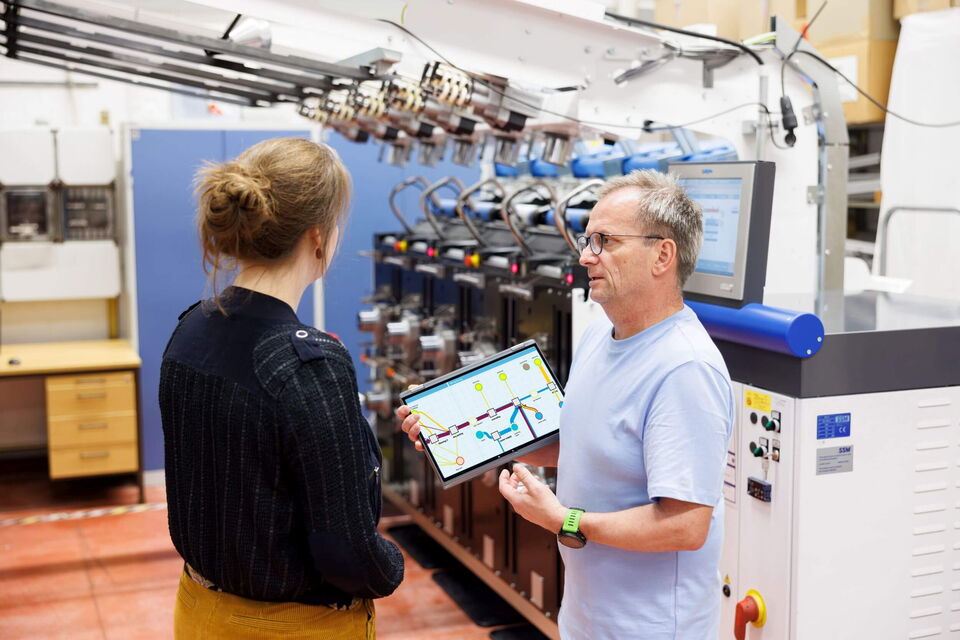
To make sustainability measurable, comparable, and manageable, the DITF rely on established and standardized assessment methods:
Life Cycle Assessment (LCA)
A comprehensive analysis of environmental impacts across a product’s entire life cycle—from raw material extraction to end-of-life. One key result is the Product Carbon Footprint (CO₂ footprint).
Product Environmental Footprint (PEF)
A standardized environmental assessment method developed by the EU. The PEF explicitly accounts for the use phase, recycling, and other circular economy strategies, thereby enabling particularly consistent comparability.
Areas of Application
The sustainability assessment conducted by the DITF includes, among other things:
- Assessment of technological innovations, e.g., new recycling technologies or materials
- Comparison of product variants, e.g., different designs, materials, or manufacturing processes
- Analysis of value chain decisions, e.g., regional production versus global sourcing
- Assessment of new business models, e.g., rental, repair, or reuse concepts in line with the circular economy
Added value for companies
Through systematic sustainability assessment, companies gain:
- a solid basis for decision-making
- transparent and comparable environmental metrics
- support in developing sustainable products and business models
- clear positioning in the context of regulatory and market requirements
👉 Learn more about our specific services and support offerings on the “Sustainability Assessment” page.