DITF support companies across the entire textile value chain with a comprehensive portfolio of services:
• Environmental assessment of products and services
- PCF - Product Carbon Footprint
Quantification of greenhouse gas emissions from products and services across various life cycle phases—from the manufacturing phase (“cradle to gate”) to an expanded assessment including the use phase and end-of-life scenarios - PEF - Product Environmental Footprint
Holistic assessment of the environmental impacts of products and services across the entire life cycle (“cradle to cradle”), taking into account various impact categories as well as use and recycling phases
Analysis of cost structures
Assessment of textile processes along the entire value chain to identify optimization potential
Strategies for recycled materials
Development and evaluation of concepts for the use of recycled materials in textile products
Resource efficiency analyses
Identification and evaluation of measures to increase efficiency in production and material processes
Recyclability assessment
Analysis of the recyclability of textile products and the use of recycled materials throughout the entire life cycle
Methodological Foundations
To ensure a well-founded and comparable sustainability assessment, the DITF relies on internationally established and standardized methods:
LCA – Life Cycle Assessment (ISO 14040/44)
Comprehensive analysis of environmental impacts across the entire life cycle
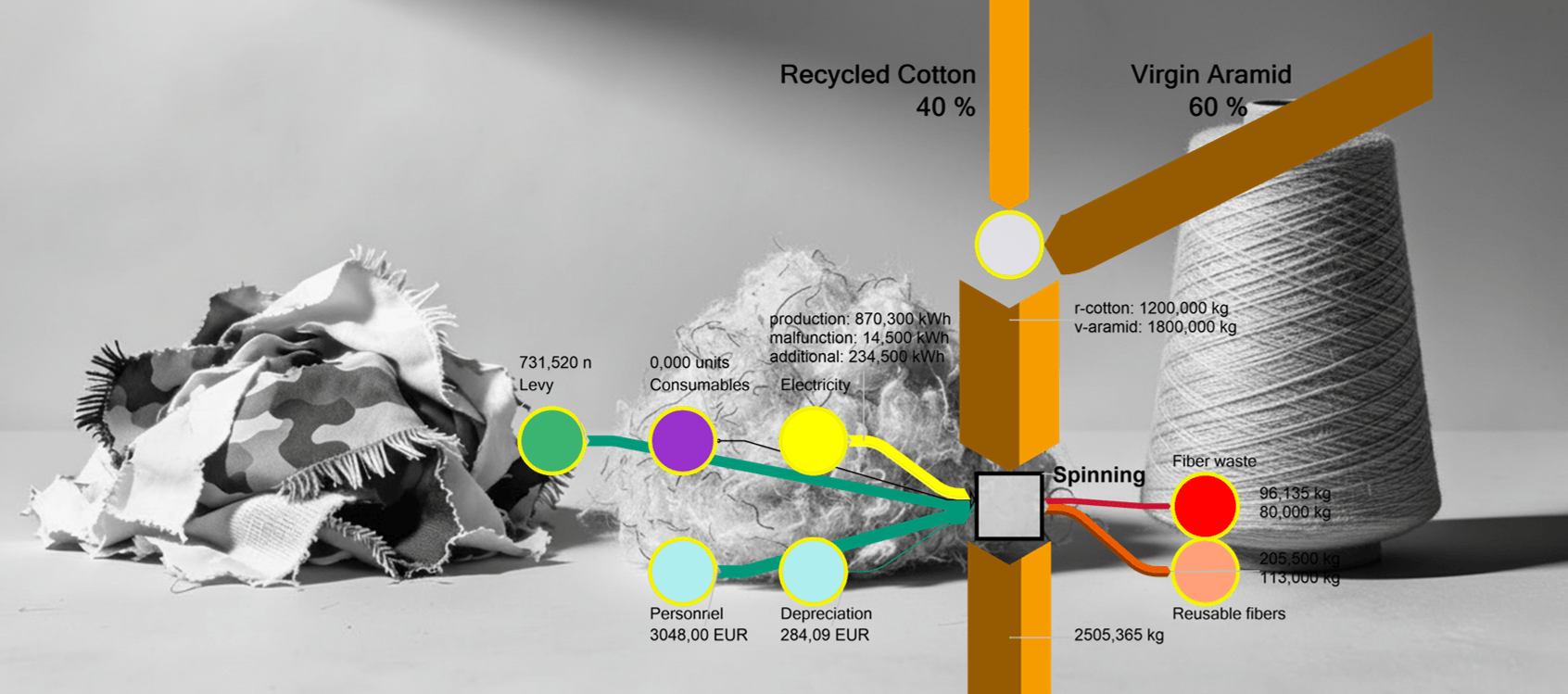
MFA – Material Flow Analysis und MFCA – Material Flow Cost Accounting (ISO 14051)
Analysis of material flows and their economic evaluation
PCF – Product Carbon Footprint (ISO 14067)
Quantification of a product’s greenhouse gas emissions
PEF – Product Environmental Footprint
EU-wide harmonized method for environmental assessment, taking into account the Category Rules for Apparel and Footwear (PEFCR)
Areas of Application
Our services support you in the following areas, among others:
- developing sustainable products
- evaluating innovation and recycling technologies
- optimizing supply chains and production strategies
- implementing circular economy concepts
- preparing for regulatory requirements and reporting obligations
Your Benefits
With DITF’s services, you benefit from:
- reliable and comparable environmental metrics
- well-founded decision-making criteria for strategy and product development
- transparency throughout the entire value chain
- practical support in implementing sustainable solutions
Would you like to assess the sustainability of your products or processes?
Contact us—we’ll support you from analysis through implementation