Digital collection development
Individual potential analyses with the help of material flow cost accounting
The digital transformation continues to advance in the apparel industry and offers numerous potentials – from virtual product development to the direct involvement of customers and retailers. However, for SMEs in the industry in particular, these opportunities are also faced with many challenges: Individualization, flexibilization and sustainability are just a few that need to be overcome. Ever-increasing competition and cost pressure are also not making the transition to digitization any easier. The DITF is conducting research in this area with a focus on the collection development and production process. As part of the AiF research project “Digital Collection De- velopment”, it was shown how apparel companies can tackle these challenges with manageable effort and realize digitization with the help of a successive transformation.
The procedure was tested on the basis of case studies from various members of the project advisory committee who are active in different product groups (accessories, sportswear, wor wear and children's clothing). Here, individual potential analyses were carried out taking into account a parameterizable model for calculating material, personnel and environmental costs (MFCA – Material Flow Cost Accounting). Individual phases along the collection development process and existing velopment”, it was shown how apparel companies can tackle these challenges with manageable effort and realize digitization with the help of a successive transformation. The procedure was tested on the basis of case studies from various members of the project advisory committee who are active in different product groups (accessories, sportswear, workwear and children's clothing). Here, individual potential analyses were carried out taking into account a parameterizable model for calculating material, personnel and environmental costs (MFCA – Material Flow Cost Accounting). Individual phases along the collection development process and existing tools were analyzed, and suitable
digitization scenarios were defined and coupled with the potential of the case studies. The results help to evaluate the costs associated with digitization, the time required, but also the necessary qualification requirements, and thus form the basis for enabling SMEs in the apparel industry to digitize with the help of a step-by-step implementation.
CONTACT
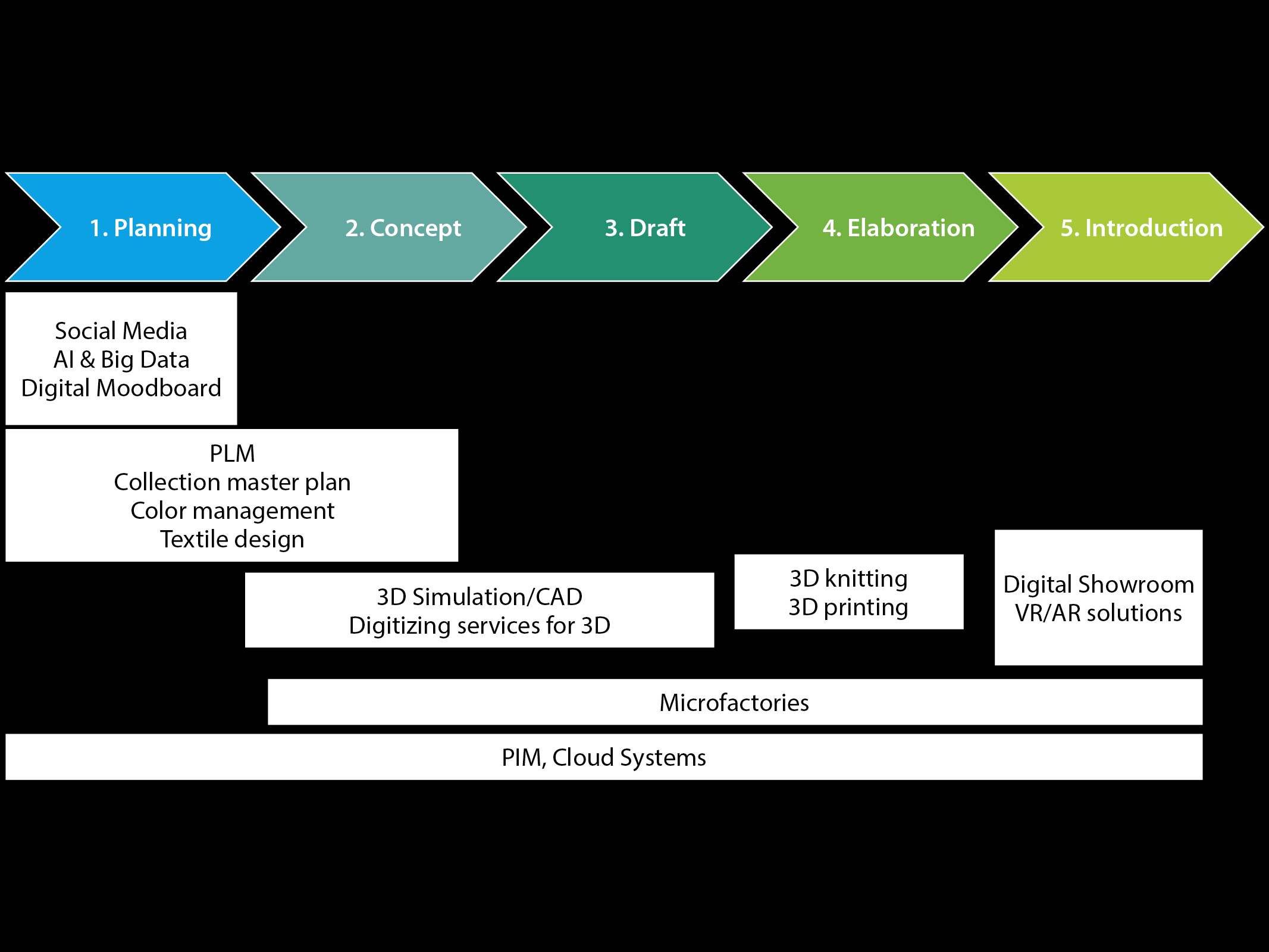
Analysis of the digitization potential of individual phases along the collection development process with existing tools