CONTACT

Head of Center of Management Research
AI, Data, Digital Production
Projects at the Mittelstand-Digital Center for Smart Cycles
The Mittelstand-Digital Center for Smart Cycles provides small and medium-sized enterprises with free, vendor-neutral support for digitalization and AI. The focus is on digital applications for value creation cycles, ranging from digital platforms to networked production. The DITF is a key transfer partner at the center and contributes numerous projects in collaboration with companies. We present three of them here.
Project 1: Digital Made-to-Measure Clothing
Deralife GmbH, based in Reutlingen, offers customizable premium dog coats in its online store. To further digitize its production, the company is leveraging DITF’s expertise in patternmaking and AI. The project focuses on how analog patterns, measurement data, and variants can be integrated into a seamless digital process.
In an initial workshop, the project team analyzed what data is collected, how much of it is available, and how it can be transformed into an automated made-to-measure process. In addition, the existing pattern-making, measurement, and production processes at were analyzed, compared with ideal specifications, and jointly structured. Building on this, a concept for digital base patterns and variant logic, as well as requirements for suitable CAD and data structures, is currently being developed. The end result will be a roadmap for data-driven product development designed to prevent production errors and manual rework.
Project 2: From Data to an AI Strategy
How does a specific AI use case become the starting point for a company-wide AI strategy? A project with RÖKONA Textilwerk GmbH & Co. KG from Tübingen explored this question. The company manufactures technical textiles, such as shading textiles for panoramic roofs in automobiles.
At RÖKONA, several IT systems operated in parallel without being fully integrated with one another. These data silos hindered automation and the deployment of AI. The goal was therefore to establish the data foundation for future AI deployment within the ERP system. The first use case focused on AI-supported quotation calculation.
It became clear that not every data structure that had evolved over the years should be transferred unchanged into an AI application. Instead, a practical approach is needed. Generative AI is intended to help employees arrive at well-founded calculations more quickly through structured inputs.
The project also sparked cross-departmental collaboration. This led to the decision to develop a company-wide AI strategy and systematically build AI expertise.
Project 3: AI-Ready for Composite Materials
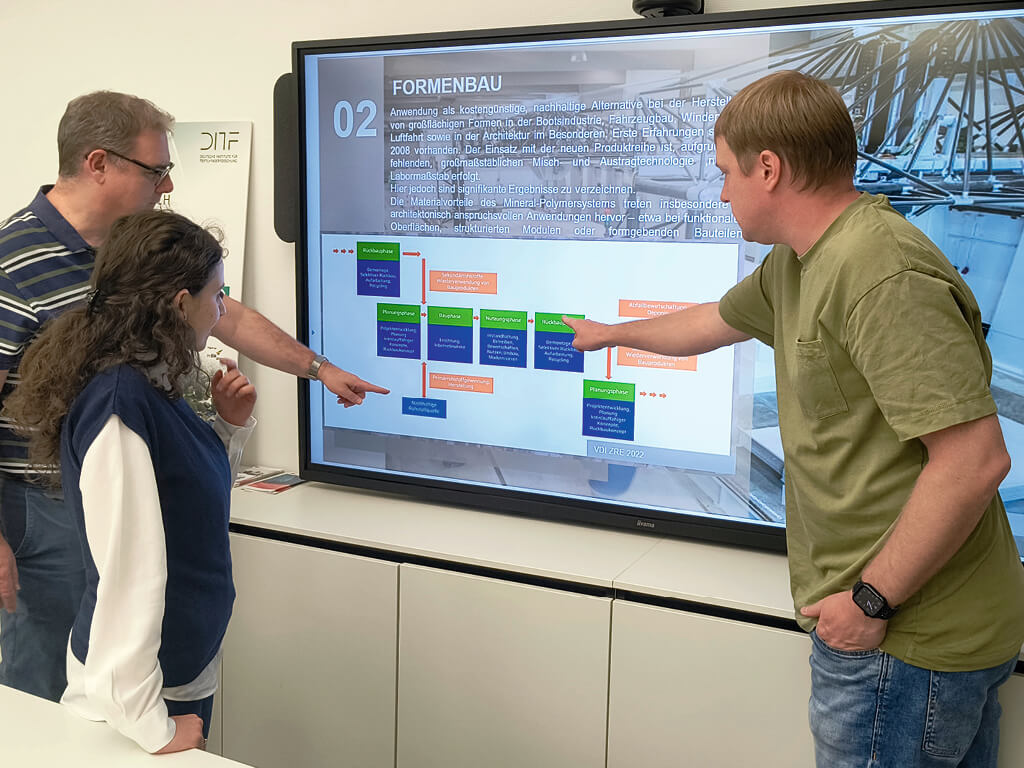
The Hessian company FACTICS optimizes manufacturing processes for composite materials that also incorporate renewable materials. The components produced in this way are suitable for use as acoustic elements or wall cladding and can be combined with storage functions for energy, heat, or water. Together with the DITF, the company is investigating which process parameters are critical for reliable production. The use of natural fibers makes this search particularly challenging. In addition, the project is analyzing how data interfaces with the participating companies should be established to ensure efficient data exchange throughout the process chain.
First, the project partners evaluated potential AI applications. The DITF team then analyzed the current manufacturing steps with an eye toward the future target process and identified which data is generated where and how it can be exchanged with machine manufacturers and software providers. The goal is to detect errors early, speed up coordination, and ensure consistently high component quality.