CONTACT

Competence Center Textile Chemistry, Application & Environmental Technologies
Barrier textiles

Head of Competence Center Textile Chemistry, Application & Environmental Technologies
Two sustainable projects, two awards
FlexHolz and FormLig receive Techtextil Innovation Award

Materials made from domestic, renewable raw materials are becoming increasingly attractive as they reduce CO2 emissions, prevent microplastics from entering the environment, and close the material cycle. Against this backdrop, the DITF are working on a variety of research projects aimed at replacing synthetically produced, predominantly petroleum-based materials with nature-based alternatives. Two projects in this field, developed in close collaboration with industry, have now received the Techtextil Innovation Award.
NUO FlexHolz
A project consortium comprising Schorn&Groh GmbH, NUO GmbH, and the DITF have developed the decorative composite material NUO FlexHolz - a highly flexible material made from real wood veneer, hemp or cellulose fabric, and a newly developed lignin-based adhesive layer. It consists entirely of renewable raw materials and is biodegradable. What makes this application particularly noteworthy is the material use of lignin, which until now has been primarily used for energy production. By eliminating synthetic adhesives, CO₂ emissions and microplastics are further reduced.
The material combines the natural look and feel of wood with the flexibility of textiles. It can be bent and shaped without losing its quality and is suitable for demanding design applications.
The technical basis is precise laser microsegmentation: After lamination, only the veneer layer is finely structured, while the textile substrate and lignin layer remain intact. This enables high flexibility, lasting dimensional stability, and - depending on the design - acoustically effective surfaces. NUO FlexHolz can be used in a variety of applications, such as in automotive interiors, interior design, furniture manufacturing, or the apparel industry.
FormLig
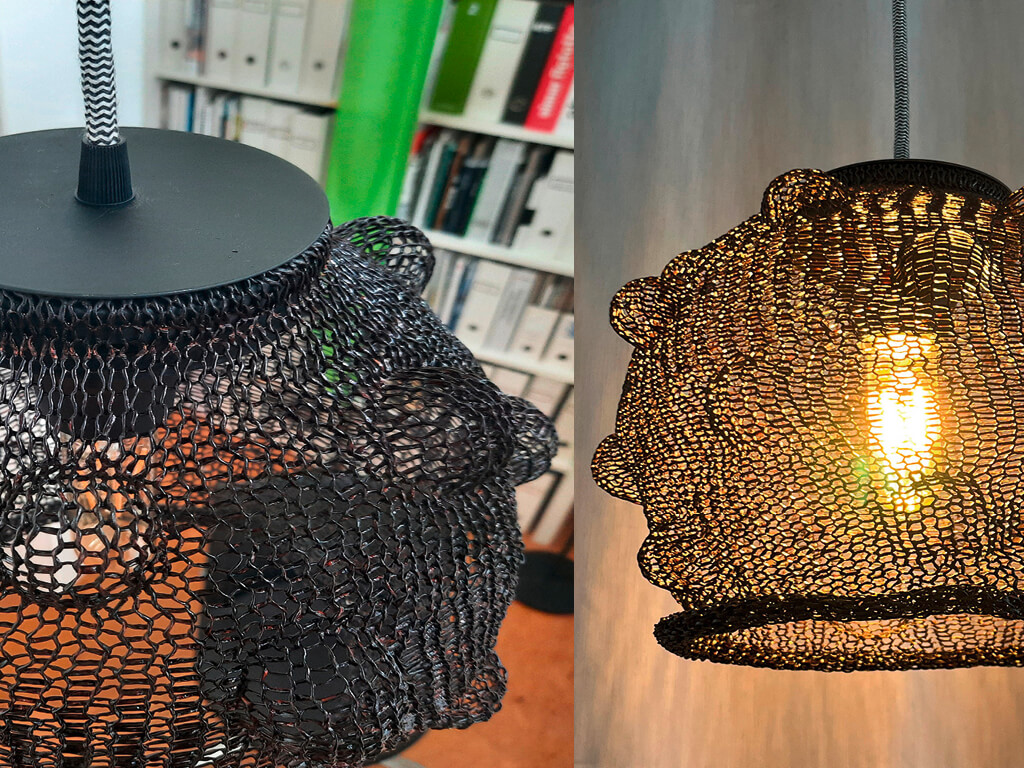
The material concept behind “FormLig” is based on coating cellulose yarns with lignin-containing compounds, followed by knitting into a semi-finished product and thermal shaping. The knitting process produces a semi-flexible knit fabric that fuses into an open-cell composite material through the targeted melting of the lignin coating. Shape and stiffness can be adjusted over a wide range. The material can be shaped almost freely in three dimensions and allows for a variety of geometries.
FormLig consists exclusively of biodegradable raw materials. Cellulose and lignin can be sourced from regional value chains. Lignin is a byproduct of the paper industry and has previously been used primarily for energy. Its material application opens up new sustainable potential.
In light of growing environmental impacts from fossil-based plastics, FormLig offers an innovative alternative. The composite combines renewable resources with functional material properties, providing a fully biodegradable substitute for synthetic polymers. This process generates neither microplastics nor landfill waste, and bound CO₂ is not released.
The material is currently in the prototype phase but shows great market potential. FormLig combines ecological responsibility with technical performance and opens up new design and application possibilities. In addition to the DITF, project partners include the Spek DESIGN studio and the companies Buck and TECNARO.